
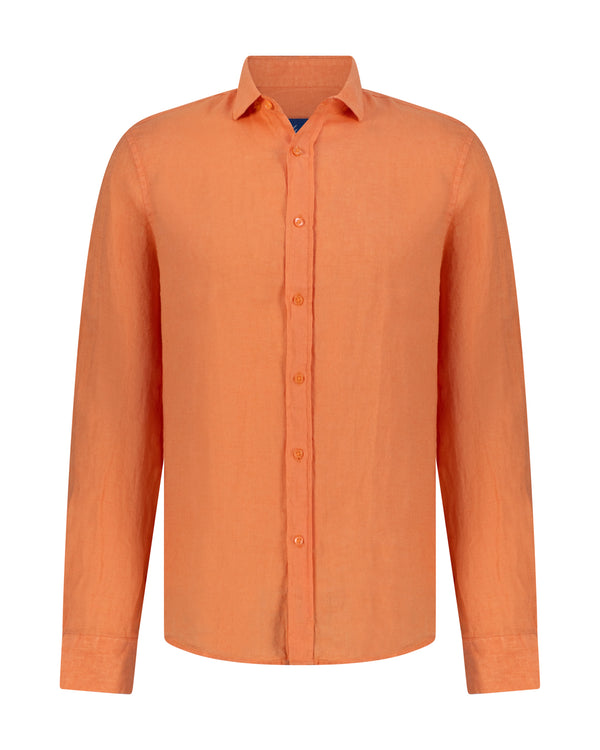


A shirt is a small architecture. The collar holds the face. The shoulder carries the line. The cuff finishes the gesture. Each is a separate decision; together they make the piece. We have spent years refining ours, and the answer keeps simplifying.
The cloth
We work, almost always, with cloth woven at the mill — a town in the northern hills that has milled wool and cotton for shirting since the 14th century. The water there is unusually soft, which matters more than is obvious; soft water lets a fibre swell and relax during finishing, and that is the difference between a cloth that holds a crease and a cloth that drapes.
For the warmer months we lean toward 120-thread cottons and the lighter linen blends — silk, very occasionally, for evening pieces. None of these have been chosen because they're rare. They've been chosen because they iron well, wash well, and improve with wearing.
The cut
Our shirt block is sometimes called "relaxed considered" and sometimes "Milanese drape". Both terms point at the same thing: a body that is generous without being slack, a yoke that lets the shoulder breathe, a back that doesn't pull when you reach. We have a small allowance through the chest — twelve millimetres, no more — and the rest of the room sits under the arm where it belongs.
The best shirt is the one you stop noticing by 11am.
The finish
Every shirt that leaves the studio has been pressed twice and inspected by hand. The collar and cuffs are sewn closed, not folded shut. Buttons are mother-of-pearl, attached with a shank — a small loop of thread between button and cloth that lets it sit cleanly over the buttonhole. Cheap shirts skip the shank. You can always tell.
If you carry one of our shirts to be repaired or altered — taken in, lengthened, re-cuffed — we'll do that for as long as the cloth lasts. That is the only commitment we make about a piece: that we'll keep it living for you.